Sirens and Snakes Water Spirits in the Arts of Haitian Vodou
In that location are several families or "nanchons" (from "nations") of loa or vodou spirits. These nanchons are: Rada (too Radha), Petro (likewise Pethro, Petwo), Nago, Kongo, Djouba, Ibo and Ghede (too Guede, or Gede). Nigh used are the principal divisions of the Rada and the Petro nanchons. While these vii nanchons all accept their distinct attributes, in a more than full general manner the nanchons are divided into these ii branches, each of which takes its name from one of the nanchons within it.
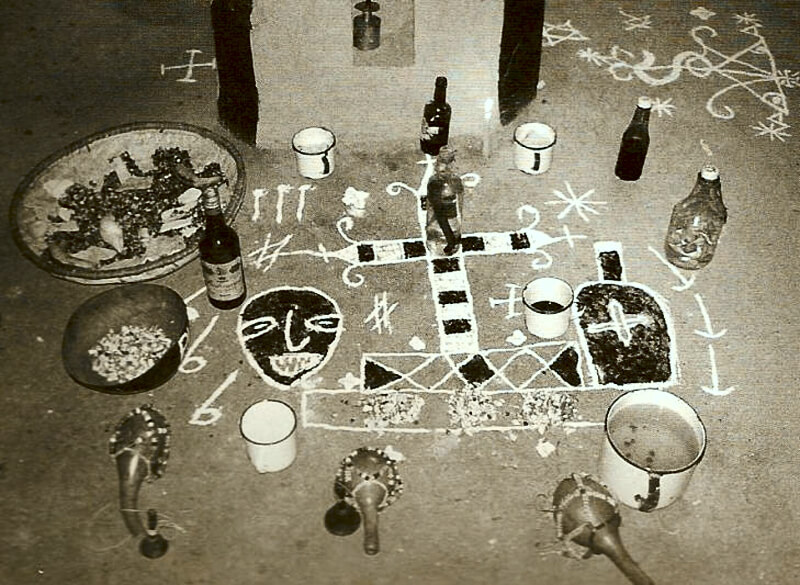
Westhile in that location is no consensus on this point, it can generally exist argued that the Rada branch includes the nanchons Rada, Nago and Djouba, and the Petwo branch includes the nanchons Petwo, Kongo, Ibo and Gède. Some people identify Djouba under the Petwo Co-operative, and some others consider the Kongo branch its own entity. Some other nomenclature is in Rada, Petro and Ghede nanchons.
| RADA | PETRO | RADA & PETRO | GHEDE |
| Adjasou Agassou Ayida Ayizan Brise Damballah Erzuli Freda Filomez Gran Bwa Legba Loco Simbi Andezo (in sweet water) Sobo Kessuo | Agau Bakulu Bade Bosou Koblamin Cong Congo Savanne Erzuli Danto Erzuli Jan Petro Gran Simba Ibo Lele Jean Petro Kalfu Krabinay Linglessu Marinette Simbi Andezo (in ocean water) Soybo Taureau trois graines Ti-Jean Petro | Agwe Marasa Obatala Ogoun Simbi Andezo | Azacca Baron Samedi Linto Maman Brigitte |
1. Rada loa
The loa of this nanchon are strong, but chivalrous, balanced in their treatment of their servants. These are the well-nigh revered spirits, and many Vodou rituals begin with adulations for them. The Rada loa are more often than not erstwhile loa, as many of these spirits come from Africa and originate from the faith of the Fon people of Dahomey (present day Benin). The Rada Loa are mainly water spirits and many of the Rada loa are served with a water. The Rada are "Cool" in the sense they are less aggressive than the Petro loa. Rada loas, however, are often considered to besides have Petro aspects—which are harsher and more aggressive than their Rada counterparts. Some sources describe these unlike personalities as aspects, while others depict them every bit carve up beings. Nonetheless in general Rada loas are chivalrous and creative and associated with the color white. That is, many of these spirits are served with white (every bit opposed to the specific colours of individual loa). Rada stands for light and the normal affairs of humanity. The Rada drumming and dancing is on beat whereas the Petro is offbeat. Rhythm and trip the light fantastic toe styles played for the Rada nanchon include: Yanvalou, Parigol, Zepol, Mahi, Fla Voudou and Daomé.
A voodoo priest who invokes the rada-loa is chosen a houngan. The temples where the Rada-Loa are worshipped are called hounfours. A priestess is called Mambo regardless of the type of loa invoked. Several Rada-Loa are commemorated annually at the Sodo (Saut-d'Eau) pilgrimage site.
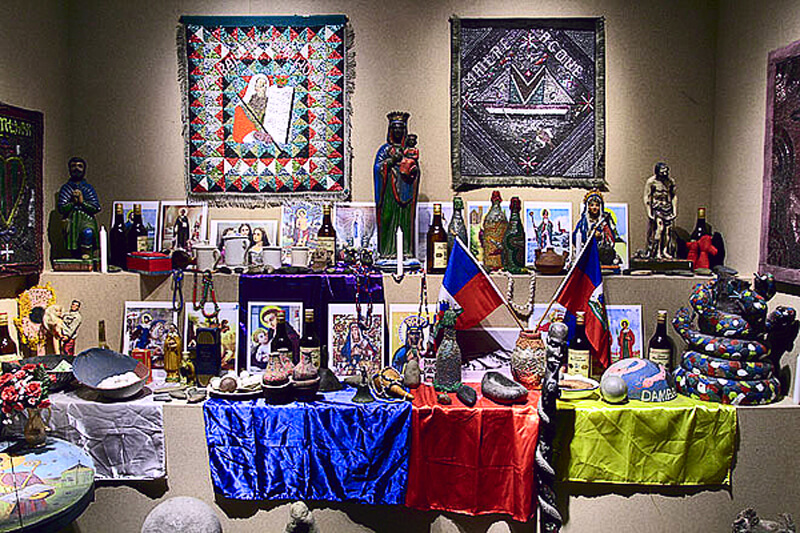
Rada altar
Important loa in the Rada Nanchon are:
• Papa Legba Atibon – He is imaged equally an old human being, St. Lazarus is used to correspond him in the hounfo or temple. He opens the gate to the spirits, and translates between human languages and the languages of the spirits.
• Marasa Dosu Dosa – They are twin children, either in twos or threes. Imaged with Sts. Cosmas and Damien, or the Three Virtues. (Sometimes classified every bit Petro.)
• Papa Loko Atisou and Manbo Ayizan Velekete – The prototypical priest and priestess of the tradition. They confer the part of priesthood in initiation.
• Danbala Wedo and Ayida Wedo – The white snake and the rainbow, together they are the oldest living beings. Danbala, the serpent spirit who represents energy and life, brings people into the Vodou. St. Patrick and Moses are used for Danbala.
• Ogou Feray – He is a fierce general who works difficult for his children but tin be moody and sullen at times every bit well.
• Ogou Badagri – He is a diplomat, and is Ogou Feray'south main rival.
• Ezili Freda – The spirit of honey and femininity. She is a mature lite-skinned woman who enjoys the finest things, jewelry, expensive perfume, champagne etc. She is said to ain all men (or she thinks she does) and can be very jealous. She gives romance and luxury. She is so pure she must never affect the bare ground. Her primary rival is her sis Ezili Dantor.
• Agwe Tawoyo – He rules the body of water and those who have crossed the bounding main, and is symbolized by his boat named "Imammou". St. Ulrich is his saint analogue.(Sometimes classified as Petro.)
• Lasirèn – mistress of the sea and music.
• Filomez – She is a water spirit that is served with pastel colors such equally blue, pink, and sometimes even dark-green. In some Vodou houses, she is the younger sister of Erzulie Freda. In others, she is not. Filomez is considered to be a very rare, yet potent, loa.
Some loa, exhibiting both beneficent and subversive aspects, belong to both the Rada and warlike Petro-Nachon. This is true of Agwe, Erzulie, and Simbi Andezo, amongst others.
Voodoos and Obeahs
ii. Petro or Petwo loa
The loa of this nanchon are ambitious, demanding, quick and protective and are more oftentimes associated with darker subjects and practices. The origins of this nanchon are unclear, just many believe them to exist the spirits of the original slaves and Haiti's ethnic people (The Taino – almost completely wiped out after European contact), a sort of "dwelling house-grown" family of spirits. In contrast to the onetime African Rada-nanchon the loa of the Petro-nanchon are mostly newcomers and associated with Republic of haiti and the New World. These spirits were called upon during the slave revolts beginning in 1791 which ultimately led to the defeat of Napoleons troops in 1803 and independence in 1804. The name might be derived from a slave priest of mixed African and Spanish Claret name Don Pedro who was 1 of the rebellion's leaders. One of the loas in this nanchon bears his name (Jean Petwo).

Petro loa Erzuli Dantor. Famous for bringing victory to the Haitians during the revolution afterward a black squealer was sacrificed to her.
Some individual loa of the Petro Nanchon
The Petro loa are generally the more fiery, occasionally ambitious and warlike loa, and are associated with Haiti and the New World. Typical representatives of the Petro loa include Ezili Dantor, Marinette, Met Kalfu (Maitre Carrefour, "Master Crossroads"), Ogoun, Krabinay, and Ti-Jean-Petro. Ezili Danto – sister to Ezili Freda in the Rada nanchon – is a spirit of love, only with a penchant for violence or revenge.include Some loa, which have both beneficent and destructive aspects, belong to both the Rada and Petro-Nachon at the aforementioned fourth dimension. This is true of the spirit beings Agwe, Erzulie, and Simbi Andezo, amid others. In African voodoo, 2 groups of loa existed, called Congo (similar Congo Savanne) and Ibo (like Ibo Lele), which were similar to the Petro-Loa. In Haiti, they are considered groups of distinctly cruel loa within the Petro Nachon.
Rites
The Petro rites are an integral role of the initiation ceremony (Kanzo), the rite by which serviteurs are initiated as priests and priestesses (houngans and mambos) of Haitian Vodou. The Bat Ge, the ceremony that precedes the Kanzo, is dedicated to the Petro loa, and the paquet congo created by and for new initiates are made under the watch of the Petro spirits.
Mistakenly the Rada loa are refered to as "proficient" and the Petro as "evil." This is incorrect; the Rada loa can be used to brand malevolent magic, while the Petro tin can heal and exercise beneficial workings. They are more accurately referred to every bit "cool" and "hot," respectively. The drums, dancing, and rhythm are offbeat precipitous, and unforgiving, like the crack of a rawhide whip. The traditional color of the Petro loa is red and the rhythm and dance styles associate with Petwo include Petwo, Makiya, Bumba, Makanda, and Kita.
iii. Nago loa
The loas of this nanchon represent power. Its members embody attributes of warriors and leaders. They originate from the Yoruba people of s-western Nigeria and are closely associated with Ogun (sometimes written Ogou), the Yoruba Blacksmith-God. The loas in this grouping have names starting with Ogoun or Ogun, like Ogun Fèray and Ogun Badagri. As such, they are represented by steel and burn down. The Nago rites are replete with military machine imagery. These spirits give masculine, fatherly council and support. The rhythm and trip the light fantastic style associated with these rites is also chosen Nago.
4. Djouba loa
The loa of this nanchon are continued to cultivation and farming. They personify peasants, both in advent and manner. Information technology is surmised that this nanchon comes from the island of Martinique. The main loa for this group is Azaka. The rhythms and dance styles associated with this nanchon are Djouba (Matinik) and Abitan.
Spiritual Fetichism
5. Congo or Kongo loa
The nanchon Congo is a complex fanmi where their complexity is well demonstrated amidst the Simbi lwa. In Congo these spirits were called basimbi and designated the spirits living around ponds, rivers and fresh waters. They were at times considered to be a class of spirit composed of highly developed ancestral spirits. The Simbi ranges from the balanced and chivalrous, as we find in Simbi Andezo to forms like Simbi Macaya, the lwa that was adopted as patron for the Bizango cult formed past Makandal during the rebellion in 1757. Simbi Macaya is seen as violent and dangerous and information technology is said that slave masters were sacrificed to him in the time of Makandal. The Congo petro rites are said to be bakongo in origin, and some say that information technology is the bakongo manner that informed Petro rituals likewise as many secret societies and more obscure rites, such as Zandor. The patron for the Zandor rites is Ti Jean Zandor and Erzulie Zandor, but it too count in its fold, Krabinay, Marinette and Simbi Yan-Kita. The Kita lwa being a sub division within the Congo nanchon together with Boumba, Caplau, Kanga and Mandange. Co-ordinate to Metraux the Congo division is also parted into Congo du bord de la mer, "Seashore congos" and Congo savane, 'wild congos". It is the latter that forms the influence into the Zandor rites and accept of ferocious and nefarious qualities where they impart superior knowledge of herbalism, malefica and wanga.
Human Leopards
The seashore congos are said to exist of off-white skin and possess long black pilus and exist of a superior intellect and possess better manners than the wild or interior congospirits. This class propose a connectedness with La Siren and Agwe and therefore with the potency of prophecy, dreams and inspiration. Interestingly information technology seems that this class of lwa was already known in Haiti prior to the population from Africa as the Tayino Indians knew a spirit called Zimi, said to have a copper red hue and long blackness hair, living around springs and fresh waters. Unremarkably these spirits are called Ti-Simbi.
Simbi Andezo is the Simbi that, like Leghba and Danballah possesses the perspective that sees two sides at the aforementioned time. Like Leghba he opens the crossroad for entrance into the rite, but Andezo opens the crossroad between the rites themselves. He possess the power to make the sweet into vinegar and the sour into honey. He is a Simbi of inspiration and secrecy, and albeit shy and difficult to know, every bit all Simbis, he possess a unique Janus qualities betwixt the Rada and Petro rites where he brings a form of equilibrium between the sides. The Catholic imagery used to display Simbi varies from Moses to St. Charles Boremeo, only quite typical the Three Magi Kings are used to represent Simbi and thus the 6th of January becomes an important day for the celebration of this mystery.
The more balanced Kongo loa are gracious, and enjoy song and dance. In fact, music played for the Kongo nanchon is unique in that it is also popular in secular settings. In vodou worship houses called tanp (from the French temple) dolls representing these spirits are displayed adorned in brightly coloured clothing. Spirits include Kongo Zando and Rwa Wangol, many Simbi loa and Marinette, a fierce and much feared female person loa, who is too classified every bit a Petro loa.The rhythm and trip the light fantastic toe mode associated with this nanchon goes past the aforementioned name.
6. Ibo loa
The loa of this nanchon are from the Ibo people in s-eastern Nigeria. Their chief attributes are pride, to the point of airs, and are difficult to satisfy. These spirits preside over sacred items chosen Kanari, clay pots in which the soul of the initiate is said to reside during ritual possession. The best known loa of this group is Ibo Lélé (the chatterer). The rhythm and dance style associated with this nanchon likewise goes by the same name.
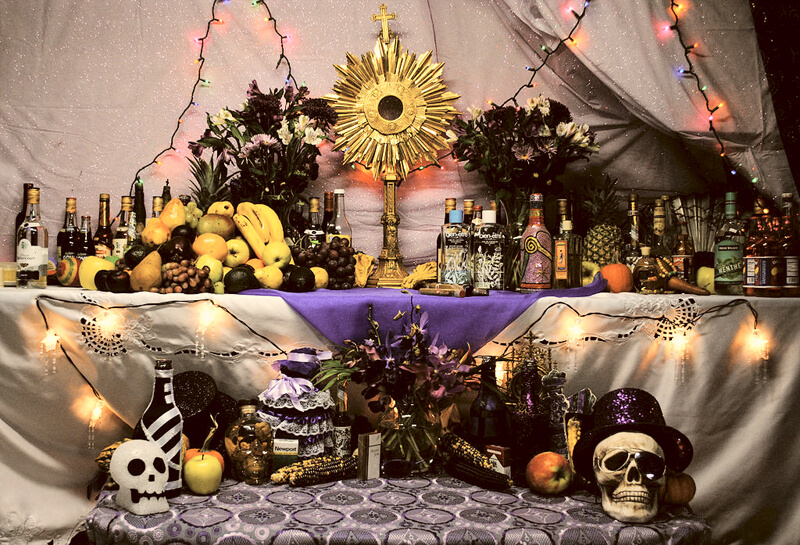
Haitian Vodou altar created for three nanchons during a festival for the Ghede spirits, Boston, MA. Top right surface area is offerings to Rada spirits; summit left to Petro spirits; bottom to Ghede
7. Ghède loa
The loa of this nanchon are are associated with the expressionless and also with carnality and eroticism. More accurately they control the cycle of expiry and life. They are also the intermediaries between the living, and the dead. Ghede loa take the capability to read people minds and to know everything that happens in both worlds. If a child is dying, Ghede is prayed to. It is believed that he will not take a life before it's time and will protect the piffling ones. The Ghede are represented by figures in black with white faces. They ship dead souls, behave irreverently, make obscene jokes and perform dances that mimic sexual intercourse. The Ghede loa celebrate life in the midst of expiry and are also tricksters.
They are the largest family Loa in Voodoo. There numbers are only known to their Begetter, Businesswoman Simityè (Baron Cemetery) and their Mother Grann Brijit. (Grand Female parent Brigitte, Maman Brigitte). The latter and the Barons (La Croix, Samedi, Cimitière, Kriminel) also dominion and lead the Ghede. The most famous loa of this nanchon is Baron Samedi. He is macabre, obscene and lives in cemeteries. Other loas include Gède Nibo, Businesswoman Lakwa and Gède Zarien.
Bated from occupying an extremely of import place in Voodoo, the Ghede are the goofiest. As a family are loud, rude (although rarely to the point of real insult), sexual, and usually a lot of fun. As those who accept lived already, they have nothing to fear, and frequently volition brandish how far past event and feeling they are when they come through in a service—eating glass, raw chillis for example. Their favorite potable is Piman Kleren a peppery rhum with 21 hot peppers soaked in it. They love it so much, that they cascade information technology on their body, wash their faces, and even their ballocks with it. Their presence seem to always put everyone in the assembly in a sexual type mood, some are known as gay. There's male, and female Gede. When Gede come up in possession, they habiliment sunglasses, with a missing lens, some cover their faces with baby powder. They wear white, black or regal clothing. They gossip and put people'due south embarrassing secrets out, at the leisure of laughs from participants, but pull ane aside, and enquire him a serious question; he volition give you the best respond that he can requite. Some has the funniest name. Ghede Pete (Ghede the farter), Ghede Egare (Gede the retarded), are some of them; simply at that place are also, some respected, quondam, wise and very rare. Such as Brav Ghede Nibo. (The Brave Ghede Nibo). Nibo is the proper noun of an ancient village in Nigeria. Ghede Avoka, (Ghede the Lawyer), Ghede Mazaka, Ghede Zariyen (Ghede the Spider)
Gede'due south feast are usally historic throughout Republic of haiti, on November 2d, in reference to its clarification of Tous les Saints (All Saints Day). Huge crowds are on the streets, en route to cemeteries. Drums are beaten, candles are lighted, songs are sung; VèVè are drawn on the grounds. It is a existent political party. Black Goats are sacrificed for them. The rhythm and dance style associated with this nanchon is called Banda. Their traditional colours are black and royal.
A popular song for Brav Gede goes:
Brav Gede alovi e
M'pat vin isi pou'm ret a moun o
Fouye twou a se mwen, antere a se mwen (bis)
Mwen pat vin isi pou'm ret ak moun o
Brav Gede Alovi eh
I didn't come here to be anyone'southward servant
Digging the pigsty; it's me. Burying; it's me (bis)
I didn't come hither to be anyone'south servant.
Anansi
You may as well similar to read:
Voodoo King Doctor John
New Orleans Superstitions
Voodoo
Pomba Giras and Exu's
Gris gris, mojo bag and borfima
Mami Wata
Palo, Hoodoo
Santeria, Umbanda, Vodum
Sanite dede Regina Nicaud
Datura stramonium – Jimson weed
Source: https://vamzzz.com/blog/the-seven-nanchons-or-loa-families-in-vodou/
0 Response to "Sirens and Snakes Water Spirits in the Arts of Haitian Vodou"
Postar um comentário